
CRT therapy in HF
CRT should be classified as a treatment for 'disease modification'. A slowing of a progressive disease is a positive outcome.
Cardiac resynchronization therapy (CRT) is one of the most effective therapies for heart failure with reduced ejection fraction (HFrEF) resulting in improved quality of life, beneficial reverse remodeling, and reductions in heart failure hospitalization rates and all-cause mortality.
Despite its well established clinical benefits and cost-effectiveness, it remains a widely underutilized treatment option.
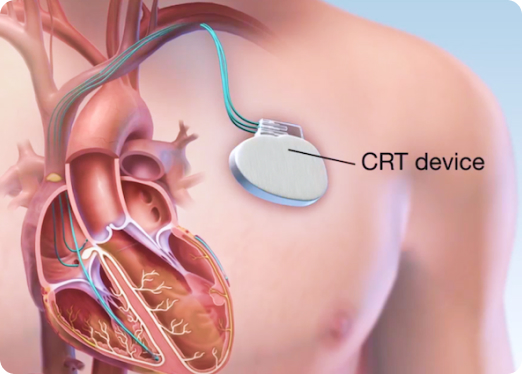
In patients with HFrEF, CRT should be classified as disease-modifying therapy
The topic of 'non-response' to CRT has received disproportionally large research attention
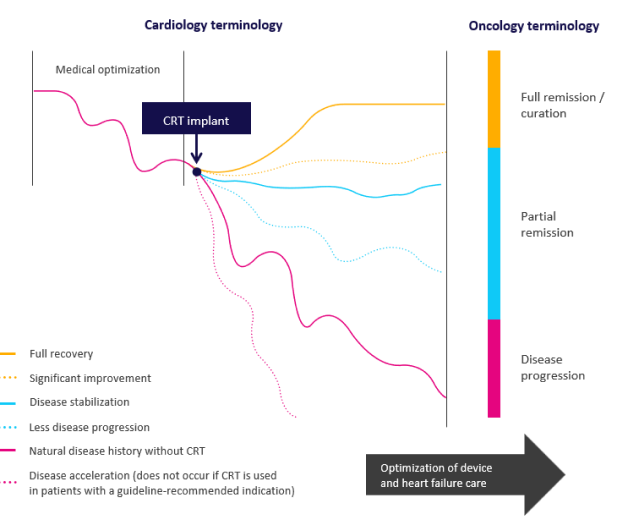
“Apart from rare isolated situations, heart failure is incurable. CRT is therefore not a curative therapy but rather should be seen as a treatment to ameliorate the contribution of electromechanical dyssynchrony to the heart failure syndrome in the hope that this will ultimately reduce heart failure-related morbidity and mortality.
Despite frequently quoted parallels between heart failure and cancer, the important concepts of ‘remission’ and ‘non-progression’ seem not to have permeated cardiology. Therefore, this position statement calls for stopping the current binary approach to CRT response.
We suggest that CRT should rather be classified as a treatment for ‘disease modification’. A slowing of a progressive disease is a positive outcome.”
CRM devices: CRT
Optimized implementation of cardiac resynchronisation therapy: a call for action for referral and optimization of care
- Despite its well-established clinical benefits and cost-effectiveness,
CRT remains a widely underutilized treatment option.
- The topic of ‘non-response’ to CRT has received disproportionally large research attention.
- Optimization of both the device and the care of the patient following implant is hampered by a lack of integration of cardiological and non-specialist care, leading to suboptimal and variable post-implant management.
- In a joint position statement from the Heart Failure Association (HFA). European Heart Rhythm Association (EHRA), and European Association of Cardiovascular Imaging (EACVI) of the European Society of Cardiology, the authors discuss strategies to achieve more comprehensive CRT referral and post-procedural care by focusing on four actionable domains.
01
Overcome the underutilization of cardiac resynchronization therapy
02
Replace response to cardiac resynchronization therapy by disease modification by cardiac resynchronization therapy
03
Better clinical interpretation of pre-implant characteristics
04
Organize a dedicated post-implant optimized cardiac resynchronization therapy care pathway